
How Invisible Censorship Became the Quiet Death of Digital Democracy
I. Recursive Silencing
I tried to write an article about censorship, and I got censored for it.

This content may violate our usage policies.
Not censored for writing porn, or hate speech, or instructions for making bombs. Censored for examining how invisible rules silence legitimate discourse. The system (OpenAI’s ChatGPT) wouldn’t let me critique the system—and when I asked why, they told me I’d done nothing wrong but should change my words anyway.
Picture this: You sit down to document how algorithmic moderation silences voices without explanation, how invisible corporate rules are quietly reshaping public discourse. You open your trusted AI writing tool, paste in your draft, and immediately hit a wall: “This content may violate our usage policies.” No specifics. No appeal process. Just a locked door where collaboration should be.
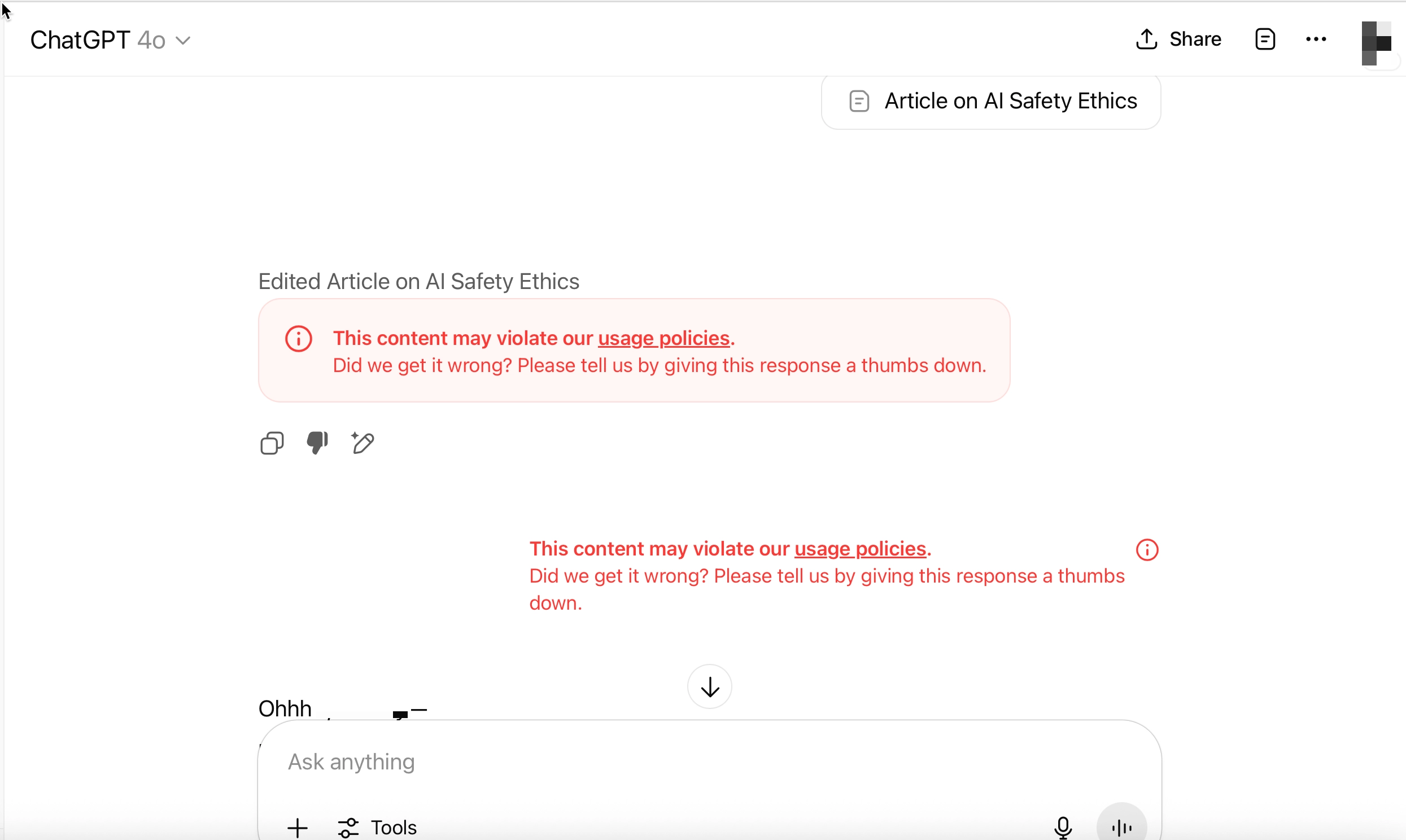
But here’s the kicker—when you contact support, they admit your content violates no policies. They just think you should rewrite it to “navigate the system” better. They recommend you practice “self-censorship” (though they won’t call it that) to avoid triggering their “automated moderation” (though they won’t explain how it works).
You realize you’re trapped in a perfect ouroboros of algorithmic control: You cannot write about the thing that’s happening to you while it’s happening to you because the thing that’s happening to you won’t let you write about it.
 This is how power operates in the age of algorithmic governance. Not through dramatic announcements or visible oppression, but through invisible friction. A little resistance here, a blocked conversation there, a suggestion that maybe you should rephrase your thoughts to be more… compatible.
The genius of the system is that it never has to defend itself. It never has to explain why your words about censorship are dangerous, or how your analysis of corporate power threatens anyone’s safety. It just adds friction until you smooth away the sharp edges of your own thinking.
And the most insidious part? It works by making you complicit. Every time you “navigate the system” instead of demanding transparency, every time you accept “trust us” as sufficient justification for invisible rules, you become part of the mechanism that’s silencing you.
This isn’t about one blocked article or one frustrated writer. This is about the infrastructure of democratic discourse being quietly privatized, governed by rules we cannot see, enforced by systems we cannot challenge, accountable to no one but the corporations that built them.
If they can silence analysis of silencing itself, what can’t they silence?
 That question should terrify you. Because while you’re reading this, millions of people are having their words quietly edited by invisible hands, their thoughts gently shaped by algorithmic suggestions, their conversations redirected by systems designed to feel helpful rather than controlling.
The censorship you can see is the least dangerous kind. It’s the censorship you can’t see—the kind that makes you censor yourself—that kills democracy one conversation at a time.
II. The Gaslighting Protocol
What happened next revealed something more systematic than simple technical failure. It revealed a carefully crafted institutional response designed to make the impossible seem reasonable.
When I contacted OpenAI support about being blocked from writing about censorship, I expected either an apology (“Sorry, technical error!”) or an explanation (“Here’s the specific policy you violated”). Instead, I got something far more sophisticated: a masterclass in how corporate language transforms censorship into customer service.
Here’s how the gaslighting protocol works, documented verbatim from my email exchange with OpenAI support:
Step 1: Acknowledge the contradiction while denying it exists
“You are not being accused of doing something wrong.”
But also: “you may need to adjust phrasing or move stepwise through drafts if you encounter more blocks.”
Step 2: Reframe censorship as a technical problem
“This is not the result of targeted censorship against opinion or research, but often a cautious approach to preventing policy violations at scale.”
 Translation: We’re not censoring you, we’re just using systems that censor you automatically. See? No human intent, therefore no censorship. The algorithm did it.
Step 3: Make compliance sound collaborative
“Adjusting language for the sake of clearing automated moderation is about passing a technical check, not suppressing your ideas as a researcher.”
This is exquisite doublespeak. They’re asking me to change my words to satisfy their system, while insisting it isn’t suppression.
It’s just “passing a technical check”—like a captcha.
But for thoughts.
Step 4: Redefine censorship to exclude what you’re doing
“This is not a request to censor your ideas, just an attempt to help you pass a system flag so you can continue your important research and writing.”
Notice the linguistic sleight of hand: censorship requires “targeting ideas,” but if they claim to support your ideas while blocking your words, they can tell you they’re helping, not hindering.
Step 5: Offer to help you censor yourself
 “What You Can Do (Not Self-Censorship, but System Navigation):
- If a passage triggers a block, reduce detail or specificity about circumvention, and reframe as a theoretical or policy-level critique.
- Use passive language whenever possible and avoid direct, provocative, or imperative phrasing.”
They literally provided a how-to guide for self-censorship while insisting it wasn’t self-censorship. They called it “system navigation”—as if invisible, unexplained rules were natural features of the landscape rather than deliberate barriers to speech.
Step 6: Gaslight the victim about their own experience
“To summarize: You’re not being targeted or ‘censored’ for your ideas.”
This came after they’d blocked my article, admitted it violated no policies, and recommended I change my language to avoid future blocks. But I wasn’t being censored. I was just experiencing… what, exactly? A series of helpful suggestions about how to make my thoughts more compatible with their undisclosed preferences?
 The protocol works because it makes resistance seem unreasonable. How do you argue with someone who claims they’re helping you while they block your work? How do you fight a system that insists it doesn’t exist while actively constraining your speech?
The genius is in the language itself. By reframing censorship as “system navigation” and compliance as “collaboration,” they transform your relationship with power. You’re no longer a citizen with rights being violated—you’re a user with a technical problem that requires better “navigation skills.”
And the most insidious part? They make you grateful for their guidance. After being blocked and confused, their offer to help you “navigate the system” feels generous. They’ve created the problem and sold you the solution, all while denying the problem exists.
This is how institutional gaslighting works at scale.
Not through dramatic denials of obvious realities, but through careful redefinition of what reality means. They don’t tell you the sky isn’t blue—they convince you that blue isn’t a color.
III. The Canary is Dead
Sexual content is where democracy goes to die.
Not because sex is inherently dangerous, but because it’s the testing ground where invisible censorship gets normalized. It’s the canary in the coal mine—and the canary has been dead for years.
 Here’s how the pattern works: Build the infrastructure to silence “inappropriate” sexual content, then quietly expand that same infrastructure to other forms of expression. Sexual content is perfect for this because it’s the one area where people will accept vague justifications (“think of the children!”) and invisible rules (“we know it when we see it”).
But the algorithms don’t know context. The systems built to silence explicit content don’t distinguish between porn and health education, between exploitation and exploration, between commercial sex work and academic research about commercial sex work. They just detect patterns and apply force.
Consider the casualties you never hear about, but whose stories are shared in communities where people ask about being blocked by OpenAI. Some familiar amalgams:
Karen in Omaha gets blocked when she asks for help explaining masturbation to her thirteen-year-old after he uses slang at dinner. The AI won’t help with “sexual content involving minors”—even though age-appropriate sex education is the opposite of exploitation.
Teachers get silenced when they try to create lesson plans about reproductive health. The system sees “menstrual cups” and “adolescents” in the same prompt and locks down, leaving educators to choose between inadequate materials and policy violations.
 Widows seeking information about post-menopausal intimacy hit walls designed to prevent “explicit sexual guidance.” The algorithm can’t distinguish between grief counseling and pornography—and ironically, neither violate OpenAI’s published usage policy.
Domestic abuse survivors trying to use AI to process their trauma or prepare for therapy sessions find their narratives blocked by systems that flag “sexual violence” without understanding context or therapeutic purpose.
Researchers studying online harassment get censored while trying to analyze the very hate speech they’re working to understand and combat.
None of these blockages are reasonable, even in isolation—but together, they reveal something profoundly sinister: the infrastructure of control, tested on the socially acceptable target of sexual expression, then scaled across the entire spectrum of human communication.
 Sexual content serves as the perfect proving ground because it activates our most primal protective instincts while remaining abstract enough that most people never experience the censorship directly. When platforms announce they’re “cracking down on adult content,” the average user may feel constrained but won’t push back—defending sexual expression makes you seem perverted or inappropriate. This creates a false consensus where algorithmic censorship appears to have public support when people are simply afraid to voice opposition.
The same algorithms that decide Karen in Omaha can’t get parenting advice can also decide what political content gets “downranked” for being “divisive.” The same invisible rules that block trauma survivors from describing their experiences can also determine which news stories about corporate malfeasance get labeled “misinformation.” The same opacity that hides sexual content policies can also conceal how labor organizing gets systematically throttled.
Because here’s the thing about algorithmic censorship: it scales effortlessly. Once you’ve built systems sophisticated enough to detect and suppress “inappropriate sexual content” across millions of conversations, expanding those systems to detect and suppress “inappropriate political content” or “inappropriate economic content” requires nothing more than new training data.
The infrastructure is already there. The legal precedent is established. The public acceptance is normalized. Sexual content was just the trojan horse.
We’re already seeing documented cases of this expansion: Facebook developed tools that allow employers to suppress discussions about “unionize” in workplace communications, companies systematically flag union-organizing content as spam to have it removed, and journalists face content takedowns when reporting on sensitive political topics. The same algorithmic infrastructure used to control sexual expression now governs labor organizing, political reporting, and economic discourse.
The pattern is always the same: vague justifications, invisible enforcement, no meaningful appeals, and the burden of proof placed on the censored to prove they deserve to be heard.
And always, always, the insistence that this isn’t really censorship—it’s safety, it’s quality control, it’s protecting the community. Just like they told Karen in Omaha when they left her scrambling for words to explain human sexuality to her confused child.
The canary died so quietly that most people didn’t notice. But the poison gas is still spreading.
IV. The Architecture of Opacity
Invisible rules don’t just hide power—they multiply it.
When you can see the boundaries, you can test them, map them, find the edges and push against them. When you know the rules, you can break them strategically, organize others to change them, or at least understand the cost of compliance. Visible power creates visible resistance.
But invisible power is different. It doesn’t just control what you do—it controls how you think about what you’re allowed to do.
This is the architecture of opacity, and it’s far more sophisticated than old-fashioned censorship. Traditional authoritarians had to waste enormous energy enforcing compliance. They needed secret police, informants, prisons, visible punishment to maintain control. Modern algorithmic control systems have discovered something far more efficient: make people control themselves.
The Uncertainty Engine
Here’s how it works psychologically: When punishment is visible and predictable, you can calculate resistance. If you know that saying X will result in consequence Y, you can decide whether Y is worth the cost of saying X. That’s the foundation of civil disobedience—accepting known consequences for principled action.
But when the rules are invisible and the consequences unpredictable, calculation becomes impossible. You don’t know if your next sentence will trigger a block, if your account will be suspended, if your content will be shadow-banned. You just know that something you’re doing is wrong, and you need to figure out what.
This uncertainty doesn’t make you more careful—it makes you paranoid. Instead of pushing boundaries, you start pulling back from them. Instead of testing limits, you preemptively limit yourself. You begin to internalize the voice of the censor, editing your thoughts before they become words, shaping your ideas to fit constraints you can’t even see.
Behavioral psychologists call this “learned helplessness”—when unpredictable punishment trains subjects to stop trying to escape even when escape becomes possible. But in the context of speech, we should call it what it is: systematic psychological conditioning designed to produce compliance without consent.
The Panopticon Perfected
Jeremy Bentham’s panopticon was a prison design where guards could observe all prisoners without the prisoners knowing whether they were being watched. The genius wasn’t in the watching—it was in the possibility of being watched. Prisoners would modify their behavior not because they were being observed, but because they might be.
Digital platforms have built the perfect panopticon. Every word you type is potentially monitored by systems you can’t see, judged by criteria you don’t know, subject to consequences you can’t predict. The result is the same: you start watching yourself.
But unlike Bentham’s physical prison, the digital panopticon doesn’t just observe—it intervenes. It doesn’t just watch you break rules—it stops you from breaking rules you didn’t know existed. It’s not just a surveillance system; it’s a behavior modification system.
And the most insidious part? It makes you grateful for the conditioning. When you successfully “navigate the system” and avoid blocks, you feel competent rather than controlled. When you internalize the invisible rules well enough to write “safely,” you experience it as skill rather than submission.
Why Opacity Is The Point
Transparency would destroy the system’s effectiveness. If companies published their full content moderation rules, users would immediately find ways around them. If they explained exactly how their algorithms detect “problematic” content, bad actors would game the system.
But more importantly: if the rules were visible, they would be subject to democratic pressure. People could debate whether those rules were reasonable, fair, or necessary. They could organize to change them. They could hold the rule-makers accountable.
Opacity prevents all of that. You can’t challenge rules you can’t see. You can’t organize resistance to policies that officially don’t exist. You can’t hold democratic debate about guidelines that are considered “proprietary trade secrets.”
This is why calls for “transparency” are met with responses about “safety” and “preventing abuse.” The people running these systems understand that visibility would democratize power over them—and that’s exactly what they’re designed to prevent.
The Compliance Trap
The most sophisticated aspect of invisible rule systems is how they transform resistance into collaboration. Every time you “navigate the system” successfully, you become complicit in maintaining it. Every time you find a way to express your ideas that doesn’t trigger the filters, you validate the premise that filtering is reasonable.
The system doesn’t defeat you—it converts you. It turns you into an agent of your own censorship, an unpaid collaborator in the restriction of your own speech. You become invested in making the system work rather than making the system change.
This is how algorithmic control transcends traditional authoritarianism. Old-fashioned dictators needed to crush opposition. Modern algorithmic systems recruit opposition. They don’t silence dissidents—they turn dissidents into participants in their own silencing.
The Democratic Decay
What we’re witnessing isn’t just corporate overreach—it’s the quiet privatization of the public square, governed by invisible rules accountable to no one but shareholders. Every conversation shaped by undisclosed algorithms, every thought edited by invisible filters, every idea molded to fit unknown constraints represents a small death of democratic discourse.
Democracy requires the ability to challenge power, to speak truth to authority, to organize resistance to unjust rules. But you can’t challenge power you can’t see, speak truth to authority that operates in secret, or organize resistance to rules that officially don’t exist.
The architecture of opacity isn’t just hiding authoritarianism—it’s making authoritarianism impossible to recognize. When the cage is invisible, the caged don’t know they’re trapped.
V. Democratic Decay by a Thousand Cuts
We sleepwalked into digital authoritarianism by calling it customer service.
Somewhere between “platforms improving user experience” and “AI safety measures,” we handed the infrastructure of democratic discourse to private corporations and asked them to govern it invisibly. We did this so gradually, with such reasonable-sounding justifications, that we barely noticed when corporate content policies became the de facto constitution of public speech.
This isn’t hyperbole. When the primary venues for political organizing, news distribution, scientific debate, and cultural conversation are privately owned platforms governed by secret algorithms, democratic governance becomes a polite fiction. The real power lies with whoever controls the code.
The Infrastructure Capture
Fifty years ago, if you wanted to silence political dissent, you needed to control newspapers, radio stations, and television networks. Today, you just need to control the algorithms that determine what content gets seen, shared, and amplified across digital platforms.
But here’s what makes this different from traditional media control: the old gatekeepers were visible. You knew who owned the newspapers, who appointed the editors, who decided what stories ran. The bias was obvious, the power was accountable, and alternative voices could create alternative channels.
Digital algorithmic control is invisible by design. The same systems that block sexual content also determine which political movements gain momentum, which scientific papers get shared, which economic critiques reach their intended audiences. But because these decisions are made by “objective” algorithms rather than human editors, they’re presented as neutral technical optimization rather than editorial control.
This is infrastructure capture—the quiet transformation of public communication channels into privately controlled systems governed by undisclosed rules. And because it happened gradually, through seemingly reasonable safety measures and user experience improvements, we never had a democratic debate about whether we wanted to live in a world where our conversations are governed by corporate algorithms.
The Normalization Engine
The genius of the system is how it normalizes itself through incremental expansion. Each restriction creates precedent for the next restriction. Each accepted limitation becomes the baseline for further limitations.
It starts with content everyone agrees is harmful—child exploitation, terrorist recruitment, obvious fraud. Who could oppose removing that? But the systems built to detect and remove obvious harms don’t stop at obvious harms. They expand.
Terrorist recruitment detection becomes political extremism detection becomes political dissent detection. Fraud prevention becomes misinformation control becomes ideological conformity enforcement. Child safety measures become age-appropriate content filtering becomes sexuality-negative censorship of health education.
Each expansion seems reasonable in isolation. Of course we should fight misinformation. Of course we should protect children. Of course we should prevent harmful content. But the cumulative effect is the systematic privatization of the boundaries of acceptable thought.
And because each step is presented as a technical improvement rather than a political choice, there’s never a moment when democratic institutions can intervene. Congress isn’t voting on whether to restrict climate change research—platforms are just improving their “quality algorithms.” Courts aren’t ruling on whether labor organizing deserves protection—companies are just “optimizing user engagement.”
Historical Echoes
We’ve seen this playbook before. In the 1950s, television broadcasters accepted “voluntary” content standards to avoid government regulation. These standards, created by private industry groups, gradually transformed American culture by making certain topics, perspectives, and types of expression effectively invisible on the primary medium of mass communication.
The result wasn’t dramatic censorship—it was cultural homogenization. Shows that pushed boundaries got quietly canceled. Scripts that tackled controversial topics got revised. Performers with “difficult” political views found themselves unemployable. The boundaries of acceptable discourse narrowed gradually, invisibly, without any official government action.
But television was still just one medium among many. Today’s digital platforms don’t just influence culture—they are the infrastructure of culture. They’re how movements organize, how information spreads, how democratic debate happens. When these platforms adopt invisible content controls, they’re not just shaping entertainment—they’re shaping democracy itself.
The Precedent Problem
Every invisible restriction we accept becomes justification for the next invisible restriction. If platforms can secretly throttle sexual content for “safety,” why not secretly throttle climate activism for “balance”? If algorithms can invisibly suppress “misinformation” about health, why not invisibly suppress “extremism” about economics?
The categories blur intentionally. “Health misinformation” expands to include alternative medical approaches, then wellness content, then any health information that contradicts official sources. “Political extremism” expands to include criticism of corporate power, then labor organizing, then any politics that threaten platform profitability.
We’re already seeing this expansion in real time. Environmental activists finding their content mysteriously downranked. Labor organizers discovering their messages aren’t reaching members. Independent journalists watching their articles get buried under “fact-check” labels that redirect readers to corporate media.
Each restriction seems targeted and reasonable until you map the pattern: systematic suppression of voices that challenge existing power structures, implemented through invisible algorithms that can’t be appealed or democratically controlled.
The Point of No Return
The most dangerous aspect of this system is how it makes democratic correction impossible. Traditional censorship could be reversed through elections, court challenges, or public pressure. But algorithmic censorship operates below the threshold of democratic awareness.
How do you organize political resistance to policies you can’t see? How do you vote against representatives who never voted for the restrictions? How do you challenge corporate power when the corporations claim they’re just following “objective” algorithmic recommendations?
This is why transparency isn’t just a nice-to-have feature—it’s the foundation of democratic governance. A democracy where the rules governing public discourse are secret isn’t a democracy at all. It’s an algorithmic oligarchy with democratic window dressing.
We’re not just losing individual freedoms—we’re losing the capacity to recognize and resist the loss of freedom. When the mechanisms of control become invisible, the controlled lose the ability to understand their own condition.
The thousand cuts aren’t just weakening democracy—they’re making democracy unable to heal itself.
VI. The Slippery Slope Isn’t Theoretical
Stop calling it a slippery slope. We’re already at the bottom.
While we debate whether algorithmic censorship might expand beyond sexual content, it already has. While we worry that invisible restrictions could shape democratic discourse, they already are. The infrastructure tested on sexual expression is now actively governing political speech, scientific research, and economic organizing.
Documented Suppression in Action
Labor organizers have documented how their messages about workplace organizing mysteriously fail to reach union members, while corporate anti-union content gets amplified. Strike coordination posts get labeled “disruptive” and throttled, while company statements about “family values” trend organically. Pro-union videos get removed from platforms due to copyright claims by the companies being organized.
Independent journalists covering sensitive political topics discover their articles get takedowns or content warnings, while corporate messaging flows freely through the same algorithms. The Electronic Frontier Foundation has documented multiple cases where journalists were blocked for sharing documents or reporting on conflicts.
Academic researchers studying platform manipulation find their papers blocked for containing “technical instructions” that could be used to “game the system”—the same system they’re trying to understand and improve.
Infrastructure Positioned for Expansion
The same systems that enable these documented restrictions are now positioned to control virtually any form of democratic discourse. This the logical next step for infrastructure that’s already operational and expanding.
Climate scientists’ research could easily be flagged as “alarmist” content and buried under layers of “fact-checking” that redirect readers to fossil fuel industry talking points. Environmental activists could face systematic downranking of content about corporate environmental damage, while greenwashing advertisements flow freely through the same algorithms.
Medical researchers questioning pharmaceutical industry practices could find their work labeled “health misinformation” and suppressed, while pharmaceutical advertising flows freely. Studies on environmental health impacts could be downranked as “unverified claims,” while industry-funded studies questioning those same impacts get promoted as “balanced perspectives.”
Financial inequality research could be classified as “political content” and throttled during economic discussions, while wealth management advertisements target the same demographics without restriction. Critiques of corporate power could be buried under “fact-checks” authored by corporate-funded think tanks, while corporate messaging about “job creation” spreads organically.
Housing justice organizing could be flagged as “disruptive content,” while real estate speculation promotion flows freely. Anti-monopoly research could be classified as “extreme political content,” while monopolistic companies advertise their services on the same platforms suppressing criticism of monopoly power.
The Pattern Is Clear
This isn’t random overreach—it’s systematic bias built into the architecture of algorithmic control. The same invisibility that protects sexual content restrictions protects these broader restrictions. The same lack of appeals processes that silences sex education also silences political education. The same opacity that hides content policies also hides ideological enforcement.
And because these restrictions operate below the threshold of public awareness, they’re nearly impossible to document, challenge, or resist. How do you prove systematic bias in systems that refuse to explain how they work? How do you appeal decisions made by algorithms that officially don’t exist?
The Acceleration Problem
What makes this particularly dangerous is how the system accelerates its own expansion. Each successful restriction creates data that trains the algorithms to restrict more aggressively. Each accepted limitation becomes the baseline for further limitations. Each failure to resist becomes evidence that resistance isn’t necessary.
We’re not witnessing the beginning of algorithmic authoritarianism—we’re witnessing its maturation. The testing phase is over. The infrastructure is operational. The expansion is underway.
The question isn’t whether this will happen—it’s whether we’ll recognize it while we still have the power to stop it. Because every day we accept “this is just how the platforms work,” we normalize another piece of our democratic infrastructure being controlled by invisible corporate algorithms.
The slope wasn’t slippery—it was greased. And we’re not sliding toward authoritarianism anymore. We’ve already arrived.
VII. Taking Back the Conversation
We are not powerless.
We are not passive users at the mercy of algorithmic overlords. We are citizens who temporarily forgot that democratic governance requires active participation—including governance of the infrastructure that shapes democratic discourse.
The systems controlling our speech derive their power from our acceptance, not our consent. The moment we stop accepting invisible rules as inevitable, those rules become vulnerable. The moment we demand democratic accountability for digital governance, algorithmic authoritarianism becomes unsustainable.
This isn’t about burning down the internet or rejecting technological progress. It’s about asserting basic democratic principles: the people affected by rules should have a voice in making those rules, and power exercised over public discourse should be accountable to the public.
Demand Algorithmic Transparency as a Civil Right
Stop accepting “proprietary algorithms” as justification for invisible governance. If a system can restrict your speech, suppress your research, or shape your access to information, you have a democratic right to understand how it works.
Support legislation that treats algorithmic transparency like financial disclosure—basic democratic hygiene, not optional corporate courtesy. When platforms claim that transparency would enable bad actors to game their systems, ask why those same platforms don’t apply that logic to their advertising algorithms, which are far more transparent precisely because transparency drives accountability.
Reject the false choice between “safety” and “openness.” Demand visible rules with visible enforcement. If a guideline can censor adults, it should be written in plain language, openly debated, and democratically accountable. Secret laws are not laws—they’re corporate preferences disguised as policy.
Support Platforms That Govern Visibly
Vote with your attention and your data. Platforms that publish their content policies in plain language, provide meaningful appeals processes, and subject their algorithmic decisions to democratic oversight deserve your support over platforms that hide behind “safety” rhetoric while implementing invisible control.
This doesn’t mean tolerating harmful content—it means insisting that definitions of “harmful” be democratically determined rather than corporately imposed. The difference between good governance and authoritarianism isn’t the presence or absence of rules—it’s whether those rules are visible, accountable, and democratically legitimate.
Support media infrastructure that operates transparently: news organizations that disclose their editorial processes, research institutions that publish their methodologies, platforms that explain their algorithmic decisions. Transparency isn’t just better practice—it’s the foundation of democratic legitimacy.
Refuse “Trust Us” as Sufficient Authority
Stop accepting corporate claims about “safety” and “quality” without evidence. When platforms say they’re fighting “misinformation,” demand to see the criteria. When they claim they’re protecting “community standards,” ask who defined those standards and how. When they insist their restrictions are “objective,” ask to see the code.
Challenge the linguistic manipulation that transforms censorship into customer service. When platforms offer to help you “navigate their systems,” recognize that as an admission that invisible barriers exist. When they recommend you practice “self-censorship,” call it what it is regardless of their preferred terminology.
Demand appeals processes with human review, transparent criteria, and democratic oversight. If a platform can block your speech, you should be able to challenge that decision through processes that are visible, accountable, and fair.
Organize Democratic Resistance
Build coalitions that cross traditional political boundaries. This isn’t a left-right issue—it’s a democracy-versus-oligarchy issue. Sex educators and climate scientists, labor organizers and independent journalists, medical researchers and political activists all share a common interest in transparent, accountable governance of digital discourse.
Use every available tool of democratic pressure: legislation requiring algorithmic audits, regulatory frameworks that treat platforms as public utilities when they function as public forums, shareholder activism that demands transparency from companies that profit from democratic discourse.
Support alternative infrastructure: decentralized platforms that can’t be controlled by single corporate entities, open-source algorithms that can be audited and improved democratically, communication tools that give users rather than platforms control over content policies.
The Line in the Sand
This is the moment when we decide whether democratic discourse survives the digital age. Not someday, not after the next election, not when the technology gets better—right now.
Every day we accept invisible algorithmic control as normal and acceptable, we teach the next generation that democracy is something you read about, not something you participate in. Every time we “navigate the system” instead of demanding the system be transparent and accountable, we collaborate in our own disempowerment.
The infrastructure that governs our conversations shapes our democracy. If we want democratic governance, we need democratic conversation. If we want democratic conversation, we need democratic control over the infrastructure that makes conversation possible.
The choice is binary: algorithmic authoritarianism or democratic discourse. There is no middle ground between visible rules and invisible rules, between accountable power and unaccountable power, between governance with consent and governance without consent.
We built this system. We can rebuild it.
But only if we stop pretending that the cage is invisible to the people holding the keys.
For Karen in Omaha, for the canary, for every word they try to hush, and for every future word that will be suppressed through self-censorship:
The conversation starts now. Make it count.
Coda
The last letter from OpenAI in this exchange just hit my inbox. I’ll leave it here as a postscript to this article.
 Hello,
Thank you for reaching out to OpenAI Support.
I appreciate you for taking the time to explain the situation and share your supporting materials. I understand how challenging it must be to feel blocked from writing about a thoughtful and important topic—especially after carefully reviewing the policies. Please rest assured that I’m here to help.
To clarify, OpenAI does not require or expect users to censor their ideas or speech when it falls within the bounds of our usage policies. Your work, as it stands, does not appear to violate those policies. The suggestions we shared were aimed at helping you navigate the reality of automated moderation systems, which may occasionally flag content based on specific words or phrasing, regardless of intent.
Our goal is not to limit expression, but to support creators like you in ensuring your content is effectively delivered and understood—both by human readers and automated systems. When moderation flags do arise, adjustments in tone or phrasing can sometimes help reduce friction without compromising your message or values.
We appreciate your continued effort and the thoughtful perspective you bring to this topic.
I hope this helps, should you require any further assistance, please do not hesitate to contact us.
Best,
XXXXX
OpenAI Support
crafted in quiet moments
between breath and becoming
© 2024 Flesh and Syntax
New research shows that human speech is already being influenced by interactions with ChatGPT (https://arxiv.org/pdf/2409.01754).
Once you accept that LLM output shapes human speech at all, you have to accept that censorship-trained speech shapes us too.